Write great Grep skills
Last updated: July 12, 2026
Write great Grep skills
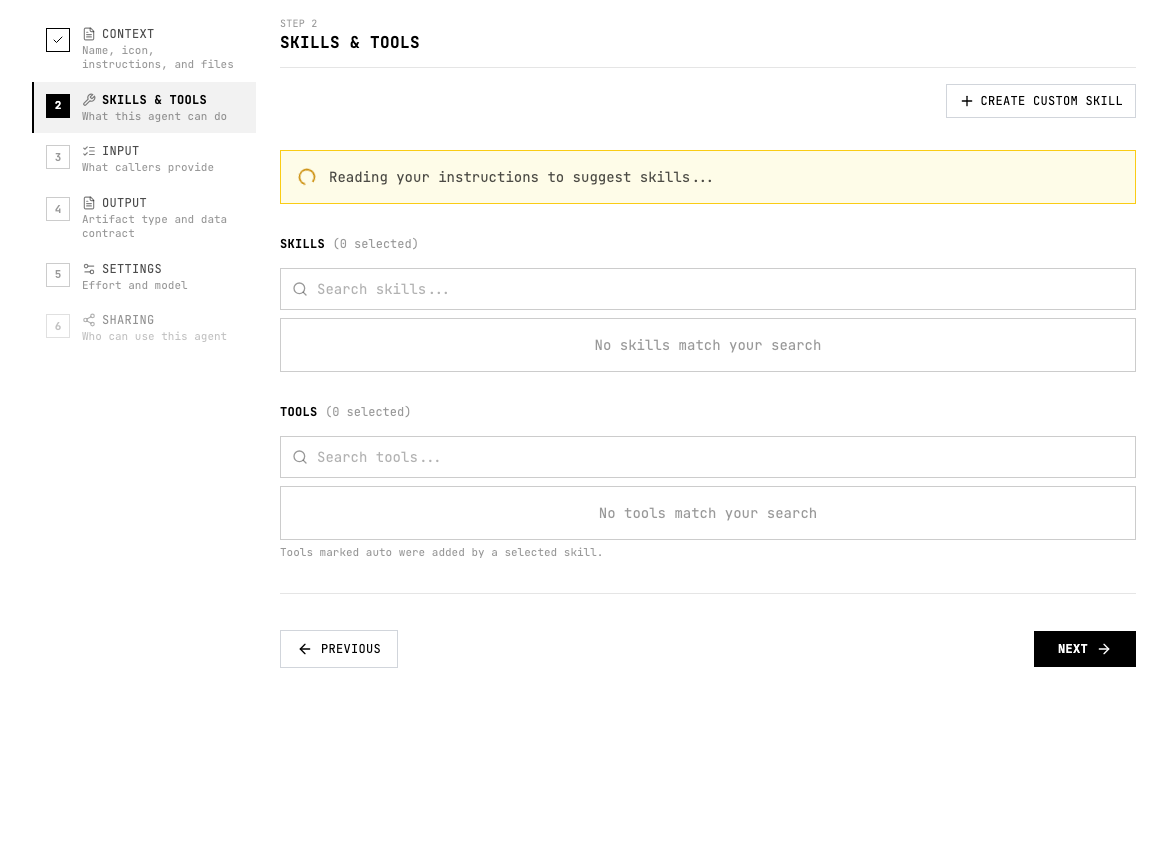
Skills are reusable instructions for a repeatable part of an agent's work. A good skill does not just say what to do. It teaches the agent how an expert performs the task, which sources to trust, how to verify evidence, when to use tools, and how to handle edge cases.
Start with the job to be done
Before writing the skill, name the exact job it should help with. A useful skill usually answers one of these questions:
- What does the agent need to research, classify, compare, extract, or verify?
- Which parts of the workflow repeat across many runs?
- Which steps need expert judgement rather than a simple tool call?
- What should the agent do when the evidence is missing, weak, or contradictory?
Do not create a skill for a vague domain such as due diligence. Create a skill for a reusable task, such as merchant website risk assessment, beneficial ownership evidence review, MCC mismatch explanation, or adverse media triage.
Research before writing
Great skills are built from meta-research. First learn how experts perform the task, then turn that method into instructions the agent can reuse.
| Research phase | What to find | What to put in the skill |
|---|---|---|
| Landscape | Key terminology, authorities, institutions, data sources, and source types. | Trusted sources, definitions, and source order. |
| Methodology | How practitioners gather, compare, and interpret evidence. | Step-by-step workflow, tool use, and decision logic. |
| Verification | Evidence standards, common mistakes, red flags, and escalation cases. | Checks, confidence rules, and failure handling. |
Use this structure
A production skill should be easy for the agent to load and apply quickly. Use stable headings and short, direct instructions.
Skill purpose
- What task this skill handles
- When to use it
- When not to use it

Required inputs
- The run-specific data the skill needs
- Context files or tools it expects

Workflow
1. Gather sources
2. Extract relevant facts
3. Compare against policy or rubric
4. Decide confidence and escalation
5. Return the required output fields

Evidence standards
- Trusted sources first
- Cross-check important claims
- Cite source and timestamp when useful

Edge cases
- Missing evidence
- Conflicting evidence
- Ambiguous classification
- Human review triggers
Write for reuse
The skill should make future agents more consistent. Keep durable methodology in the skill and keep case-specific information in inputs.
- Name the sources or tools the skill should use first.
- Define the order of operations, not just the final answer.
- Include thresholds, allowed values, and escalation rules where possible.
- Tell the agent what not to infer when evidence is weak.
- Include one good output example for the shape and level of detail.
Quality checklist
- The skill has one clear job.
- The trigger for using the skill is obvious.
- The workflow is ordered and testable.
- The skill identifies trusted sources and weak sources.
- The skill explains how to handle missing or contradictory evidence.
- The output fields or report sections are explicit.
- The skill includes at least one example or rubric.
- The skill can be tested against known good and bad cases.